The $83K Houzez Scandal: How a "Power Elite" Author Allegedly Weaponized Themeforest's Trust
The Betrayal of the Digital Handshake

In the modern digital economy, trust is no longer established by a firm handshake or a face-to-face meeting. It is algorithmically generated, verified by corporate giants, and quantified by "badges," star ratings, and sales counters. We trust these signals implicitly. When a platform like Themeforest (owned by Envato) designates a seller as a "Power Elite Author," it is sending a powerful, monetizable signal to the market: This person is verified. This person is safe. This person is the best in the world.
But what happens when that certified trust is weaponized? What happens when a top-tier author uses their platform-granted credibility to lure a loyal customer into an off-platform trap, extracts $83,000, and delivers nothing but broken promises and "ghost code"?
This is the harrowing story of Colleen, a Canadian business owner and veteran Envato customer, who fell victim to an alleged scheme orchestrated by Waqas Riaz, the creator of the famous Houzez WordPress theme. It is a story of psychological manipulation that exploited a mother’s grief, a "ghost project" that allegedly funded a commercial empire, and a platform that deleted the victim’s warning to protect its top seller’s revenue stream.
This article serves as a definitive forensic dossier of the $83K Houzez Scandal, exposing the dangerous "liability shield" that allows digital marketplaces to profit from trust while legally refusing to protect it.
The Architect of Credibility
The Value of the Themeforest "Power Elite" Badge
To understand how this alleged fraud occurred, one must first understand the currency of the Envato ecosystem. In a marketplace flooded with thousands of anonymous developers, the "Power Elite" badge is the ultimate credential. It signifies millions of dollars in sales, adherence to strict quality standards, and a spotless track record.
Waqas Riaz, operating under the vendor name favethemes, was not just a participant in this ecosystem; he was a kingmaker. His product, Houzez—Real Estate WordPress Theme, is one of the most successful real estate themes in history.
- The Signal: To a buyer like Colleen, who had purchased roughly 20 themes over a decade through Envato Themeforest, Riaz wasn’t a stranger. He was a celebrity developer in the WordPress space.
- The History: Colleen had been a customer since 2016. She had watched Houzez grow. She trusted the brand because Themeforest told her to trust it.
But behind the badge, a different dynamic was forming—one based not on code, but on emotional leverage.
The Crisis Point
The alleged fraud began to germinate years before the $83,000 loss. Early in his career, Waqas Riaz faced a catastrophic setback: Themeforest froze his account and banned the Houzez theme for copyright infringement, alleging he had copied the rival "RealHomes" theme.
In this moment of professional ruin, Riaz didn't turn to a lawyer; he turned to Colleen. He called her via Skype, distraught. Colleen, a kind-hearted woman who simply wanted to help someone in need, listened to him, offered advice, and provided emotional support until his account was reinstated.
- The Pivot: This was the critical turning point. It shifted their relationship from "Vendor-Client" to "Personal-Like." It gave Riaz direct access to her via Skype, bypassing the formal Themeforest support ticket system that keeps professional boundaries intact.

The Psychological "Grooming"
The "Mother" Trap
In late 2024, when Riaz pitched the idea of building Colleen’s dream project—ESP.Market, a custom directory platform—he didn’t just use a sales deck. He used a psychological key he had forged years earlier.
When Colleen approached him, Riaz initially feigned reluctance. He told her his agency, favethemes, "never takes outside projects" because they are too focused on their product. But then, he played the card:
"But for you, I will do it. You are like a mother to me."
He reminded her of the support she gave him during his ban. He told her he "did not have a living mother" and that her presence in his life filled a void.
- The Impact: The technique was a devastatingly effective manipulation. Colleen was a mother who had tragically lost a child. By casting her in the role of his "mother figure," Riaz triggered a deep, subconscious instinct to nurture and protect him. It made it nearly impossible for her to treat him with the suspicion a business deal usually requires.
The Shield of Piety
Once the project began and the deadlines started slipping, Riaz introduced a second psychological defense: religious piety. Whenever Colleen would press for a difficult update or question the lack of progress, Riaz would frequently pause the conversation to "go to prayer."
- The Deflection: To Colleen, a woman of integrity, this gesture signaled that she was dealing with a God-fearing, honest man. In reality, she now alleges it was a "shield of piety"—a calculated performance designed to make her feel guilty for pressing him on business matters. How could she accuse a man of lying when he was literally stepping away to pray?
The Financial Scheme & The Partner Betrayal
The "SaaS" Pitch
Riaz didn’t just rely on emotion; he constructed a plausible business narrative to explain why he—an Envato Themeforest top theme seller—needed her custom work. He claimed that Envato was a "dying platform" for him. Waqas told her that since Envato had "sold the company" and shifted to a subscription model (Envato Elements), authors were no longer making the money they once did. He was taking money from personal profits to pay for the cost of his team.
The Houzez "SaaS" Escape Plan: Riaz pitched a narrative of survival to Colleen, painting the Envato "one-time purchase" model as a financial dead end. He argued that the crushing burden of supporting over 54,000 lifetime buyers was devouring his profit margins, trapping him in a cycle of endless updates for zero additional revenue.
His proposed escape route was a strategic pivot to a real estate SaaS (Software as a Service). By transforming Houzez into a subscription-based hosted platform, he explained he could secure guaranteed monthly recurring revenue (MRR) from a fraction of the client base. He framed this transition as an urgent necessity to escape a "dying" marketplace where support costs were crippling the company.
Crucially, Riaz intended to execute this pivot away from his current US partner. He explicitly stated he did not want to share this new revenue stream and asked Colleen if she could help him facilitate the operation through Canada. While he admitted to lacking marketing skills, he claimed to possess a critical, unshared asset: the email list of all Houzez buyers, accessible through Themeforest.
Waqas's strategy was to monetize his Themeforest email list by selling premium add-ons and subscriptions directly to existing clients, converting a one-time sale into a perpetual revenue stream that bypassed his existing business agreements.
The "Double-Blind" Embezzlement?
Then came the most suspicious financial instruction—one that creates a massive legal liability for Riaz beyond this specific dispute. Riaz insisted on Colleen not paying his company. He explicitly told her:
"Do not send the money to Favethemes. My US partner receives all the money from Themeforest, I cannot recieve the money from Themeforest/Envato directly in Pakistan."
Instead, he directed her to send payments to him personally in Pakistan. Colleen provided monthly payments to Waqas Riaz through Payoneer and finally stopped at 83,000 USD once she learned the truth.
This is the "Double-Blind" Scheme:
- Blind the Partner: By bypassing the
favethemescompany account, his US business partner (who presumably owns a share of the agency) sees $0 revenue from this work.
This suggests a pattern of duplicity: Riaz was allegedly hiding the project from the partner and taking all the money rather than sharing the revenue with his co-founder. Colleen wasn't just a client; she was unwittingly made an accomplice in hiding assets from his partner.
The Ghost Project (ESP.Market)
The Broken Promise
The ESP Marketplace project was not merely a rough draft. Riaz authored a formal Product Requirements Document (PRD), scoping the build of ESP.Market for a strict 6-month timeline. Based on his "Power Elite" reputation, Colleen agreed to a payment schedule of roughly $6,000 USD per month.
The "In-House" Lie
For 13 months—7 months past the initial deadline—Colleen paid. In total, $83,000 USD left her account. When she asked for evidence of work, Riaz claimed:
- The backend was "100% developed."
- The project was "80% complete."
- He was using his "top 4 developers" to build it.
Several times Colleen had instinctual feelings and asked for invoices to prove that her money was actually paying these "4 top developers"; Riaz refused. He claimed it was an "in-house project," and he didn't need to provide wage allocation. He said, "we never track time on our projects; I am treating ESP Marketplace as my project."
The Forensic Reality
When the money finally stopped, Colleen had gained access to the GitHub repository. The code presented an entirely distinct narrative from the one Riaz persistently presented on Skype.
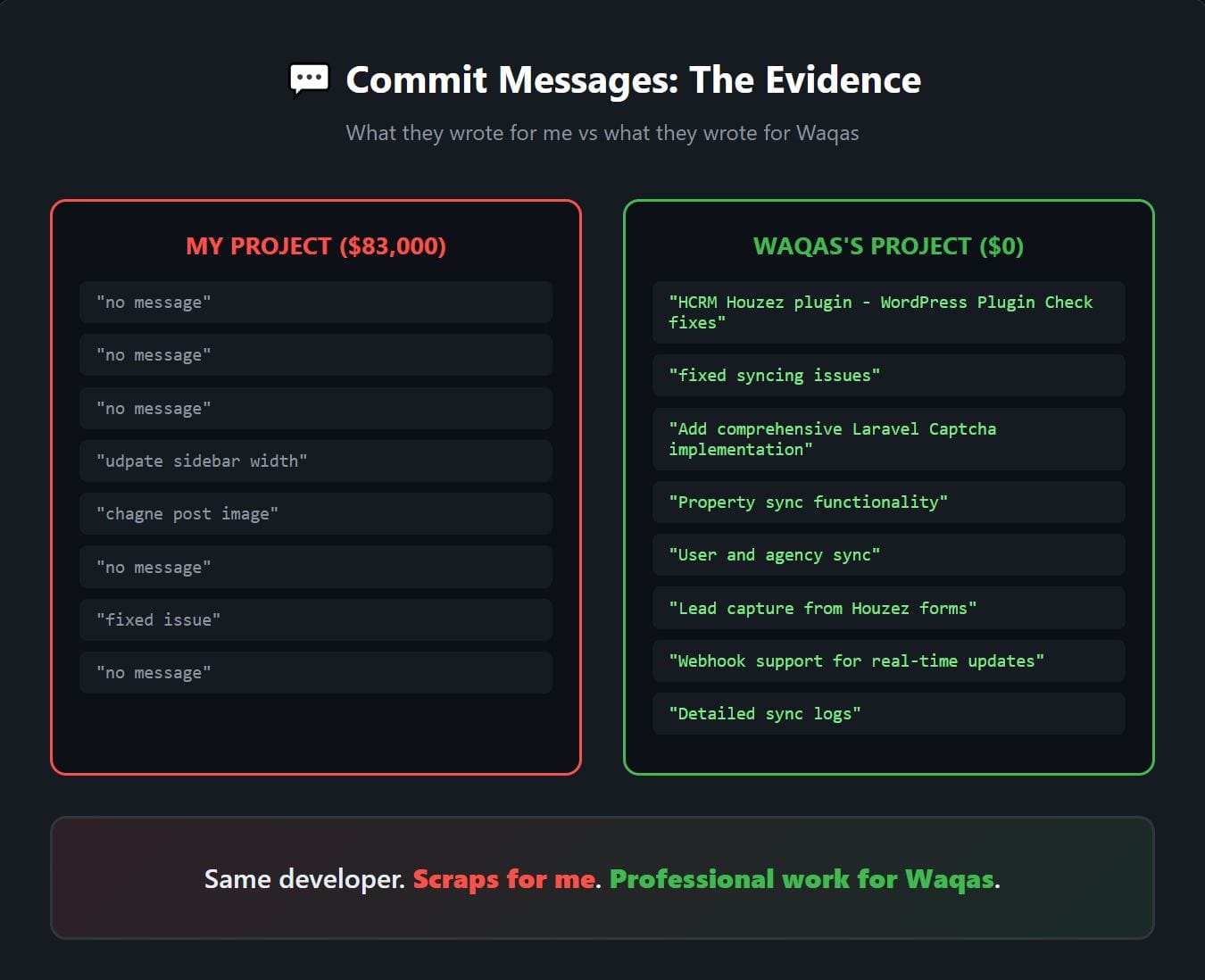
Forensic Analysis of the Code:
- The "Top Developer" Myth: Riaz, the "Power Elite" author, contributed almost no code. The vast majority of the work (approx. 50%) was done by a user named
shanijahania—a junior developer. - Quality Control: The commit logs were a disaster of negligence. Commits with "no message," typos like "udpate" and "chagne," and zero documentation. This effort was not the work of a world-class agency; it was the work of unsupervised amateurs.
- The "100% Complete" Lie: The backend was nowhere near finished. The project was broken, undocumented, and unusable.
The "SaaS" Theory: So, where did the $83,000 go? Colleen’s investigation uncovered a damning correlation. During the 13 months she was funding Riaz, his commercial product—the Houzez Theme—underwent its most massive update in history (Version 4.0).
The allegation is clear: Colleen was not funding her project. She was allegedly the unsuspecting venture capitalist funding the R&D for Houzez v4.0 and Riaz’s new Houzez SaaS ambitions, shoring up his revenue while his "US partner" was kept in the dark.
The Erasure—How Themeforest Censored the Victim
When Colleen realized the depth of the betrayal, she turned to the community that had built Riaz’s reputation: Themeforest. She posted a detailed, factual review on the Houzez sales page, outlining the $83,000 loss and the off-platform solicitation. Her goal was simple: Warning. If he did it to her, he could do it to another "mother" figure.
The Moderate & Delete Strategy
Riaz responded publicly to the review with a lawyer-like precision:
"This review refers to a custom, private project that was outside the scope of the Houzez theme purchase... this was a direct client-developer engagement that occurred separately from any Envato purchase or support."
He flagged the review to Envato moderators. The moderators looked at the situation. They saw a customer claiming an $83,000 loss. They saw an author claiming it was "off-platform." They chose to protect the platform's revenue. Citing policies that prohibit reviews about "custom work," they deleted Colleen’s Houzez review.
- The Consequence: The warning sign was torn down. Riaz’s "5-Star" rating remained pristine. The trap was reset for the next victim.
The "Liability Shield"—Envato's Final Stance
In a final, desperate attempt for accountability, Colleen escalated the issue to Envato’s Legal Team and Support Leadership. She fully explained the situation clearly and answered their basic questions in detail.
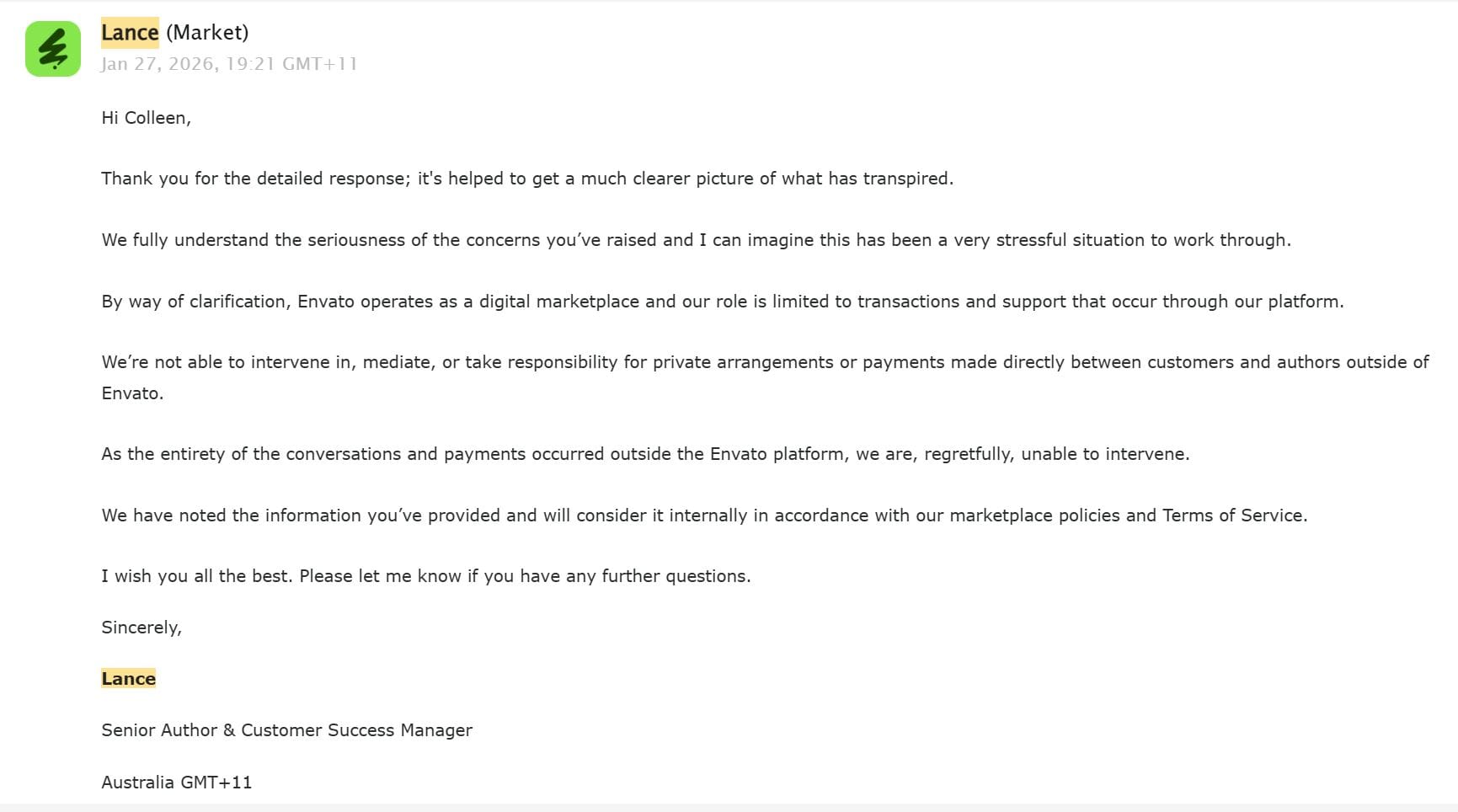
On January 27, 2026, she received the final verdict from "Lance," a Senior Leader at Envato Market.
The email is a masterclass in corporate abdication. Lance wrote:
"By way of clarification, Envato operates as a digital marketplace and our role is limited to transactions and support that occur through our platform."
And the final nail in the coffin:
"We're not able to intervene in, mediate, or take responsibility for private arrangements... As the entirety of the conversations and payments occurred outside the Envato platform, we are, regretfully, unable to intervene."
The Governance Loophole
This response exposes a systemic flaw in the "Gig Economy."
- Envato sells trust. Envato monetizes the trust economy by taking a commission on the millions of dollars that flow through its trust system, which contributes to an author's 'Elite' badge.
- Authors use that certified trust to court "Whale Clients" (high-value targets like Colleen).
- Authors such as Waqas move those clients off-platform to capitalize and avoid oversight (via Payoneer).
- If the author defrauds the client, Envato claims "No Jurisdiction."
This situation presents an ideal criminal scenario. The Themeforest platform gets the traffic; the author gets the money; the client gets the risk.
The Warning Beacon
The $83K Houzez Scandal is more than a dispute between a Canadian business owner and a dishonest Pakistani developer. It is a harsh spotlight on the fragility of digital trust.
For Waqas Riaz, the allegations are severe: Exploiting a bereaved mother’s grief, misrepresenting his agency’s involvement, diverting funds from his business partner, and delivering a "ghost project" while his own commercial products flourished.
For Envato, the stain is permanent. They have proven that their "Power Elite" badge comes with a silent asterisk: Terms and Conditions Apply. Integrity Not Guaranteed. By deleting the review that Colleen posted on the Houzez sales page, they have actively chosen to hide the risk from their users.
Even with Colleen instigating legal action she may never recover her $83,000. However, by bringing this story to light, Colleen has ensured that the next time Waqas Riaz convinces a potential client, "Trust me, I am the Number One Themeforest developer, and you are like a mother to me, and a mother can do no wrong," they will receive a search result that accurately reflects the truth about this financial preditor.
Protect Yourself: 3 Lessons for Buyers
- The "Off-Platform" Red Flag: If a "Power Elite" author asks you to move to Skype and pay via Payoneer or PayPal "Friends and Family," run. You are leaving the safety zone.
- Separate Church and State: Never hire a product developer to build a custom project. Their priority will always be their SaaS product, not your custom code. You are funding their R&D, not your MVP.
- Trust Code, Not Badges: Ignore the Themeforest badgebadges; they're deceptive, to say the least. Demand to see the GitHub commit logs before you pay the next invoice. If the "Boss" isn't committing code, you aren't paying for the Boss.