The Story Behind the Houzez Theme Review
A 64-year-old businesswoman's account of financial fraud, psychological manipulation, and the wounds that don't show up on bank statements. The Woman Behind This Story
How I Paid $83,000 to Someone I Trusted Like a Son—And What It Really Cost Me
A 64-year-old businesswoman's account of financial fraud, psychological manipulation, and the wounds that don't show up on bank statements.
I've been in business for 34 years. I am a Canadian groundwater consultant.
I began my career in the drilling and groundwater industry when most people hadn't heard of email. I've navigated and faced recessions, industry changes, difficult clients, and every challenge that comes with building something from nothing in a male-dominated industry. I've drilled for water across British Columbia for a long time. I've learned to read people, to trust my instincts, and to recognize when something isn't right.
I'm telling you this because it's important to understand: I'm not a naive woman. I'm not gullible. I didn't fall for this because I'm foolish.
I fell for it because I'm human. I trusted someone who seemed to have the best skills and be worthy of that trust. Skilled manipulators do not target weak individuals; instead, they focus on those who are generous—or situations they can easily exploit.
The First Failed Attempt: Learning the Wrong Lesson
Before Waqas Riaz of Houzez Theme, there was someone else.
I envisioned the ESP Marketplace—a platform to connect earth services professionals across North America. Engineers, well drillers, pump installers, septic contractors, and land clearing professionals are all part of my industry. My people. I knew what they needed because I'd lived it for three decades.
This was a deep passion to give back to the world, especially in the water industry.
I initially planned to build the project on Brilliant Directories, hiring an Upwork developer for the task. I invested quite a bit of money. The project failed. The money was gone. Looking back, I believe the developer attempted to customize the website far beyond the capabilities of Brilliant Directories.
Was he dishonest? He was simply an Upwork developer with a high rating who marketed himself as a Brilliant Directories expert. The project should never have been billed on an hourly basis or developed on that platform.
When I shared this painful history with Waqas Riaz, he listened. He seemed to understand. And then he said something I'll never forget:
"There is nothing you can legally do in Pakistan."
He was talking about the previous developer. He was sympathetic. He presented himself as a trustworthy individual—someone who would never engage in the same unethical practices as that previous developer.
I didn't recognize it then, but I recognize it now: he was taking notes. He was learning precisely how to manipulate me while pretending to be my protector. He told me I was foolish to trust this developer; he said all you did was give this person money so he could build up his agency. I felt foolish, and what Wasqas said never occurred to me.
The other developer owed me a couple thousand dollars and was also in Lahore. Waqas accepted my money from the dismissed developer. It was 2000 USD and it went directly to Waqas before my project even began.
Finding Waqas Riaz: Why I Thought I Was Safe
I found Waqas through the Houzez WordPress theme—one of the top-selling real estate themes on ThemeForest. Over 54,000 sales. More than 2,600 five-star reviews. Power Elite Author status, which puts him in the top 1% of Envato sellers.
Waqas wasn't some anonymous freelancer on a bidding site. This was someone with a reputation. Someone with everything to lose if they didn't deliver to Houzez has become a remarkable business. Waqas Riaz is someone whose entire business depended on trust.
I had known Waqas for many years; I was one of his first Themeforest customers who purchased the Houzez theme, and I got to know him personally during a very dark time in his life when I was there for him. I was deeply concerned for his well-being.
Ten years ago, Themeforest finally began promoting the Houzez Real Estate Theme, and sales started rolling in. It was a very exciting time for Waqas, as he really needed this project to work financially. He was still living in his village in the Pakistani countryside at that point; he was not yet in Lahore.
One day, Themeforest removed the Houzez theme from the selling platform, and all sales stopped. Waqas Riaz turned to me—someone he barely knew—for guidance and comfort. Eventually, he resolved the issues and was reinstated, but it's important to note that Houzez started with modest resources and faced numerous challenges before reaching its current status.
I was there for Waqas at that time. I thought that meant something.
I believed I was making a good choice by selecting such an individual who was so established and prominent and with whom I shared a history. I was immensely proud of Waqas.
I was wrong.
"You Are Like Mother to Me": The Manipulation Begins
When Waqas and I started working together, something unexpected happened. It didn't feel like a typical client-developer relationship. It felt personal.
In the beginning, everything felt right. I was so glad that Waqas helped me believe that ESP Marketplace would become a high-end custom platform.
Waqas was eager. He dove into the project requirements document with intensity. He said he himself built the database. He was engaged, responsive, and moving fast. He would check in on me, ask how I was doing, and show kindness beyond just the project.
For a brief period, it was everything I'd hoped for; it was just enough to hook a big fish.
That early momentum made everything that followed harder to see. When progress slowed, when communication grew vague, I kept comparing it to those first weeks. I kept believing we could get back there.
I didn't realize the beginning wasn't the real Waqas.
The beginning was the hook.
He often told me:
"You are like a mother to me."
Not once. Not casually. Repeatedly. In emails, in messages, in the way he framed our entire relationship. I was the mother figure. He wanted to be trusted as the devoted son who would take care of everything.
What I need you to understand—what I've never shared publicly before—is this:
I lost a child when I was young. I never had any more.
He knew this.
And then he called me "mother."
That wasn't just manipulation. That was surgical. He found the deepest wound I carry and positioned himself right inside it.
He knew exactly what he was doing.
"Mother Can Do No Wrong": The Psychological Trap
Then came another phrase that I didn't understand until it was too late:
"No matter what, mother can do no wrong."
Do you see the trap?
If mother can do no wrong, then when things went wrong—when deadlines slipped, when the money kept flowing out of my bank account, and nothing worked the way it should on a badly developed website—I knew I wasn't the problem. So who was left to blame? No one apparently. And if I ever questioned him, I would be breaking the sacred bond he'd built.
Waqas would speak to me like the mother abandoning her son.

He gave me a role where my only option was to trust him and keep providing money monthly. Keep trusting. Keep paying.
Because if you can't trust a man who says "you are like a mother to me" and "mother can do no wrong," then who the hell can you trust?
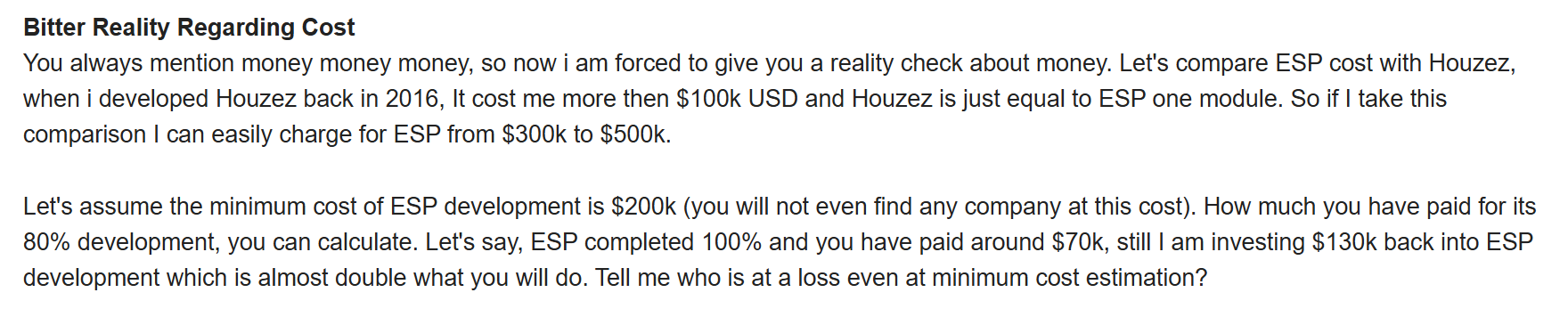
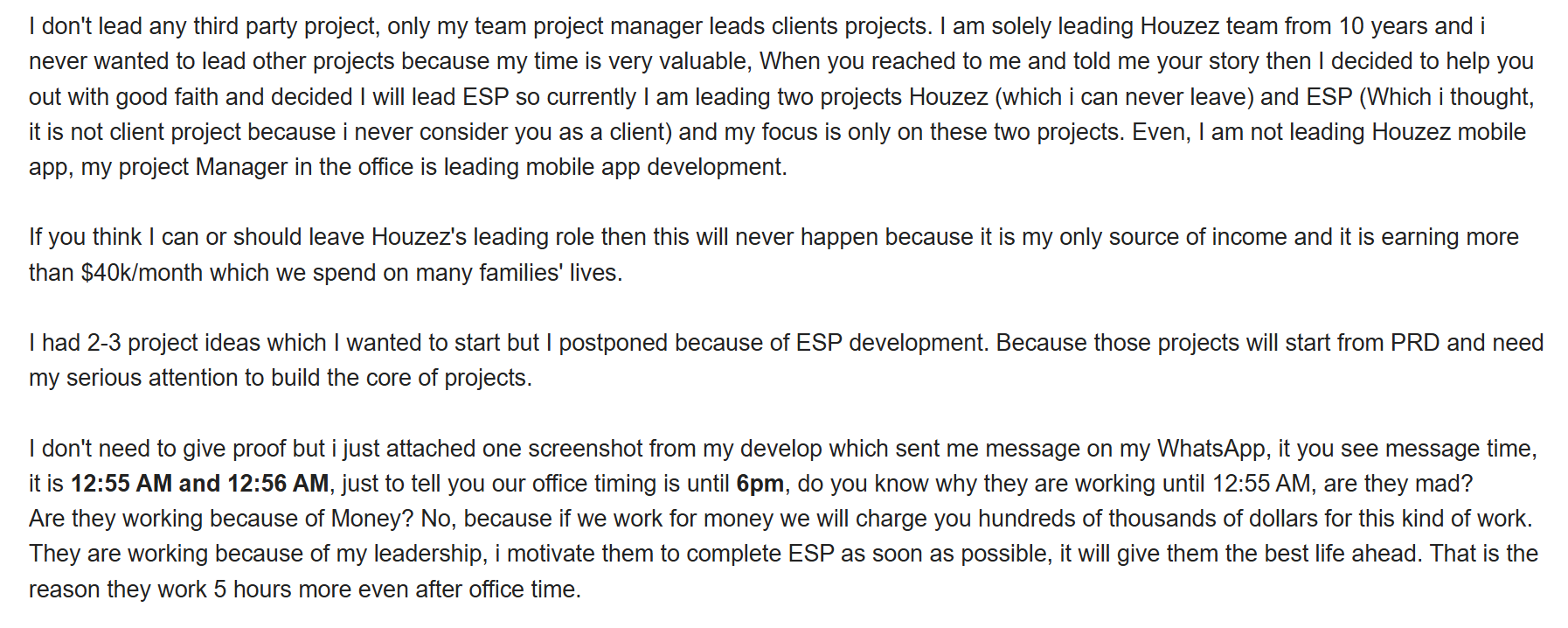
This email was sent to Waqas in May 2025 - I finally had to stop all payments after the final one in November 2025. It's only gotten worse since May.
Waqas Email Responses: You are paying $6k to developers (we are 3-4 developers).
What Waqas Claimed vs. What the Evidence Shows
Throughout our 13 months together, Waqas made many claims that I now know were false. Here is what he told me, alongside what the GitHub repository reveals:
| What Waqas Said | What the Evidence Shows |
|---|---|
| "I'm working for free on this project" | He contributed approximately 6% of the code commits, and took 100% of the money |
| "4 full-time developers are dedicated to ESP" | His developers were simultaneously building Houzez products |
| "The money barely covers developer costs" | $60,000+ appears unaccounted for based on fair market rates |
| "No Houzez developer worked on ESP Marketplace" | The same developers who built ESP created Houzez plugins before & after my payments stopped |
| "GitHub is unsafe—someone could steal your code" | They used an internal Git server the entire time, keeping me blind to progress |
Each claim kept me from seeing the truth. Each claim extended my trust and my payments.
The Reality of Those 13 Months
From October 2024 to November 2025, I paid Waqas Riaz $83,000 USD for custom development work on ESP Marketplace to be completed according to a very detailed PRD.
Waqas told me two things in the beginning: he LOVES to work, and once the PRD was complete, I would have 100% freedom; he would handle the build.
During that time, I also continued to run my drilling operation full-time. I managed a large property that I live on. I handled my responsibilities as I always have. And then every night around 8 PM, I would sit down at my computer and work on ESP until 2 or 3 in the morning, then wake at 7 AM for my day work.
Every. Single. Night.
I wasn't supposed to be this involved. Waqas told me early on that once the initial planning was complete, I would feel "free." He said he had four full-time developers dedicated to my project. He said the work was progressing well. He even did a screen share and showed me all these developers.
But freedom never came and my money never stopped
I asked Waqas for invoices. I wanted to understand where the money was going. He refused. I asked again. He refused again. I asked a third time. The answer was still no.
I asked if we could pause development to let the design phase catch up. He told me that would "kill momentum." So I trusted his expertise and kept paying.
But there was no momentum. Not on my project. The only momentum was the money leaving my account every month heading to Waqas's personal Payoneer account.
The GitHub Evidence: Following the Money
When I finally gained access to the GitHub repository, the truth was in the timestamps.
1,614 commits over 13 months. But when I analyzed who did the work:
| Contributor | Percentage of Work |
|---|---|
| shanijahania | ~50% |
| MuhammadKhalil492 | ~31% |
| Shoaib | ~9% |
| Waqas Riaz | ~6% |
| Others | ~4% |
The man I paid $83,000—the man who told me he was "working for free"—contributed approximately 6% of the code.
His team did 94% of the work. He collected 100% of the money.
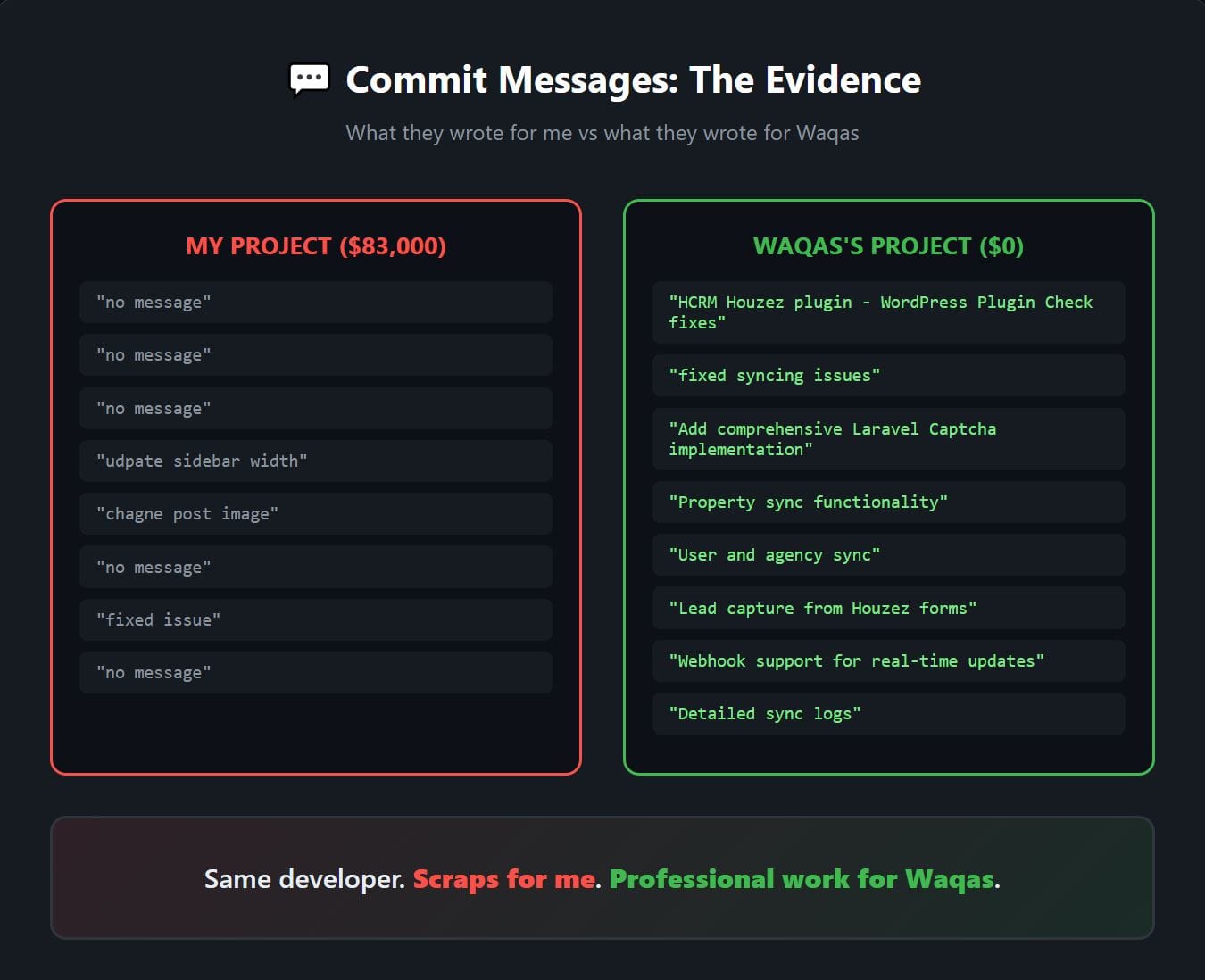
And here's what makes it worse: a few weeks after my payments stopped, the lead developer on my project (shanijahania) created a new repository for a Houzez CRM plugin. The same person who wrote "no message" on dozens of my commits suddenly produced clean, professional, well-documented code.
Muhammad Shahnawaz (shanijahania) knew how to do quality work. He chose not to do it for me.
What Independent Developers Found
I had the ESP Marketplace codebase reviewed by senior developers who had no connection to either party. Their assessment:
- Only 15-20% of the project requirements were completed
- No formal system architecture was implemented
- No database relationships were built
- The foundation and technical approach were incorrect
- The code has serious security deficiencies
- Their professional recommendation: discard the code and rebuild from scratch, or better yet, go to Wordpress!
One reviewing developer characterized the billing for this work as "very criminal."
Thirteen months. $83,000. And the unanimous expert opinion is that nothing can be salvaged; it's pretty crazy.
The Physical Cost of Betrayal
I want to tell you what the last 30 days have been like.
I haven't been able to leave my house. My chest is so tight it physically hurts. This is not a metaphor; it truly hurts. There's a weight sitting on my sternum that won't move.
I've learned that this is what betrayal feels like when it lives in your body.
The shame is suffocating. I'm a businesswoman. I'm educated and run a drilling operation. I've made thousands of good decisions. And I gave over $83,000 to someone who was lying to me the entire time.
How do you say that out loud?
I haven't told people in my life about this. I am truly horrified. There's something about being conned that feels like it says something about you—like you should have known, like admitting it means admitting you were foolish.
But I've realized something important:
The shame belongs to Waqas. Not to me.
The people who get targeted by skilled manipulators aren't the gullible ones. They're the generous ones. The ones who believe in people. The ones who, when someone says,"you're like a mother to me," feel honored rather than suspicious.
I didn't fail some test of perception. I extended trust to someone who deliberately manufactured reasons for me to trust him.
What Was Really Happening Behind the Scenes
While I was paying for "dedicated development," Waqas was having the most productive year in Houzez's entire history.
In 2025, the Houzez theme received 28 releases—more than any previous year since its 2016 launch. In June 2025 alone, there were nine releases, including a complete architectural rebuild to Bootstrap 5.3.
That kind of output requires intensive development resources. Developers working daily. Focused effort over months.
Those were the same months I was paying $6,000+ for work on my project.
My money wasn't building my platform. My money was subsidizing Houzez Theme.
Why I'm Breaking My Silence
I could have stayed quiet. Absorbed the loss. Moved on.
That's what he expected. That's what he told me would happen if things went wrong in Pakistan—"There is nothing you can legally do." He said that to me at the beginning, about someone else. He was telling me, without telling me, that he was untouchable.
But I'm not pursuing this primarily through the courts. I'm pursuing it through the truth.
The Houzez Theme Review exists because anyone considering working with Waqas Riaz deserves to know my experience. Anyone searching for reviews of his Houzez theme, his Favethemes, or his development services—they should have access to this information before they make the same mistake I did.
I have every Payoneer receipt. I have the GitHub commit history with timestamps. I have the server. I have his emails. I have the evidence, and I'm making it public.
Not out of revenge. Not to destroy someone. But because the truth deserves to be told, and because the next person he approaches deserves to know what happened to me.
The Wound Inside the Wound
There's something I need to say that goes beyond the money.
I'm grieving two things. The $83,000 and the final failure of my project, yes. But also the relationship I thought was real. I really cared for and respected Waqas Riaz.
Some part of me genuinely cared about him. That's what happens when someone positions themselves as family over a period of intentional interaction.
Finding out that person never existed—that it was a mask worn to access my wallet and my tolerance—that's not just fraud.
That's a wound inside a wound.
He pinpointed the source of my pain and exacerbated it. That's not incompetence. That's cruelty.
Waqas's real mother passed away (maybe that is a lie too), but I pray she never has to bear this shame.
For Anyone Who Recognizes This Story
If you're reading this and something feels familiar—the delayed timelines, the excuses, the emotional manipulation, the requests for money without accountability—trust your instincts.
Ask for documentation. Demand invoices. Insist on seeing the work.
I did all of this. My accountant was asking. I needed invoices for my records. Not one was ever provided.
I wanted to see timesheets—to understand the hours, to see how people were being paid on the project. His response?
"This is an in-house project. This is like our own project. We don't track time."
I believed him.
Would you?
It sounded reasonable in the moment. It sounded like he was so invested in the success of the project that he wasn't nickel-and-diming me. It sounded like a partnership, not a business transaction.
But here's what it really meant: there would never be any record of where $83,000 went. No invoices. No timesheets. No accountability. He asked me to trust him, but all I saw was my money disappearing into a black box.
If someone refuses to document their work, they're not protecting you. They're protecting themselves.
And if something feels wrong, it probably is.
You're not paranoid. You're not being difficult. You're protecting yourself.
I wish someone had told me this story before I sent that first payment. I wish I had known that credentials and reputation don't guarantee integrity. I wish I had listened to my gut when it started whispering that something wasn't right.
I can't get back my $83,000. I can't get back those 13 months. I can't undo the toll this took on my health, my confidence, and my trust.
But I can make sure you have the information I didn't have.
We Dont Track Time on Projects
I asked Waqas for all of it, as my accountant was also asking; you just don't send that kind of money overseas without documentation. I needed invoices from Waqas, but he provided none.
I really wanted to see time sheets so I could see the hours and how people were paid on the project. Waqas stated that this is an in-house project, we treat it like it's our own, and we do not track time. I believed him... would you? He had my trust.
Time to Pray
Throughout our calls, Waqas would often pause the conversation.
"I need to go pray."
And I would wait. Or we'd end the call so he could attend to his faith. I respected it. I admired it, even—here was a devout Muslim who prioritized his obligations to Allah, who paused business for something higher.
But now I have a question I can't stop asking:
How do you kneel on your prayer mat and then do what you did to me?
How do you perform salah while, in my opinion, stealing $83,000 from a woman who trusted you like a son? How do you face Mecca while exploiting a grieving mother's deepest wound? How do you submit to Allah while refusing to provide a single invoice for money that wasn't yours to take?
Islam teaches honesty in business dealings. The Prophet Muhammad, peace be upon him, was a merchant known for his integrity. The Quran warns against those who cheat others of what is rightfully theirs.
I don't pretend to understand another person's faith. But I know what was done to me. And I cannot reconcile the man who stopped our calls to pray with the man who took my money and delivered almost nothing.
Maybe the prayers were as hollow as the promises.
What I've Learned at 64
I learned to navigate GitHub to investigate what happened to my project. I learned about forensic analysis of commit histories. I learned how to build a website using Ghost CMS to tell this story—something I accomplished in days, while $83,000 over 13 months couldn't produce a functional platform.
I've learned that skilled manipulators don't target the gullible. They target the generous. They target people who give others the benefit of the doubt. They target people who value relationships and loyalty.
Those aren't weaknesses. Those are strengths. But they can be exploited by someone who knows how.
I have learned that shame is a tool that protects those who should not be protected. Speaking the truth is uncomfortable. It exposes vulnerability. It invites judgment. However, remaining silent only benefits the person who is being protected.
And I've learned that I'm stronger than I thought. This experience knocked me down. But I'm still here. I'm still fighting. And I'm making sure this story is told.
The Evidence Is Permanent
The commits are timestamped.
The payments are documented.
The emails are saved.
The truth is on the record.
This story isn't going away.
A Note on This Account
Everything written on this website reflects my personal experience, my interpretation of events, and my opinion based on the evidence I have gathered.
I am not a lawyer. I am not a software developer. I am a 64-year-old businesswoman sharing what happened to me.
The payment records are documented facts. The GitHub commits are timestamped and verifiable. The emails exist. Beyond these concrete records, the conclusions I draw are my own—based on patterns I observed, promises that were made to me, and outcomes that speak for themselves.
Others may interpret this evidence differently. Waqas Riaz may have explanations I haven't heard. I have presented what I know and what I experienced.
I believe I was defrauded. I believe the emotional manipulation was deliberate. I believe the evidence supports my account.
You are free to review the documentation and draw your own conclusions.
Related Documentation: